
Town of Marana
Pima County, Arizona
Population: 51,908 (2020 census)
Community
Cultural
Natural

Heritage Happenings
Use our Events Calendar to find events in Marana.
History
The name Marana is believed to derive from the Spanish word maraña, meaning thicket. According to local history, 19th-century railroad workers may have used the term when they had to clear thickets to build a railroad through the town.
Like all land in the heritage area, it was originally home to successive groups of Indigenous Peoples and their descendants, the O’odham and the Yaqui (Yoemem), who traveled freely between water sources, food cultivation, and important landmarks, such as sacred mountains, streams, and the sea. These tribal nations continue to thrive on this land, and without their knowledge and wisdom, the communities would not be the culturally diverse places they are today.
Archeologists found Hohokam artifacts in the Marana area near the Santa Cruz River dating 4,200 years ago. There were several agricultural sites and mounds between the Santa Cruz River and the Tortolita Mountains, giving the area a long farming history. In the 17th and 18th centuries, Spanish colonists settled in the area. In 1775, Juan Bautista de Anza led an expedition of more than 240 people through the area, camping along the Santa Cruz River, on his way to California to establish a mission and presidio at the San Francisco Bay.
In 1858, a station for the Butterfield Overland Mail stage trail was established at Point of Mountain (now Pointer Mountain). Though no structure remains, the station was located in what is now the Los Morteros Conservation Area.
Watch this short film about the Butterfield Overland Trail
Groups of Pascua Yaqui also settled in the Marana area after their 1880-1908 migration from Sonora, Mexico, and continue to reside in their community, Yoem Pueblo.
Historically, agricultural activities, including ranching, homesteading, and cotton farming were important to the development of the town. Today, Sonoran white wheat, an ancient grain introduced by the Spanish, is still grown at BKW Farms in Marana.
Distinctions
Arizona Trail Gateway Community: The Wild Burro Trailhead, located in the Tortolita Mountains in the eastern limits of the town is the starting point for many trails that lead into the Arizona Trail.
Marana High Plains Effluent Recharge Project: In partnership with Pima County, the Bureau of Reclamation, and others, the town constructed a multi-purpose facility designed to release treated effluent water into the Santa Cruz River to recharge the local groundwater aquifer, while also creating riparian areas for wildlife. Annually, the Sonoran Institute publishes Living River reports, developed to gauge the health of these valuable wetland ecosystems and track its impacts.
Arizona Memorial Veterans’ Cemetery at Marana: One of three state Veterans’ cemeteries in Arizona, the Marana cemetery offers beautiful views of the landscape for Veterans’ final resting place.
Tortolita Mountain Park & Tortolita Mountain Preserve: Explore 29 miles of trails for hiking, biking, and equestrian activities at Tortolita Mountain Park and 2,400 acres of preserved Sonoran Desert habitat in the Preserve.
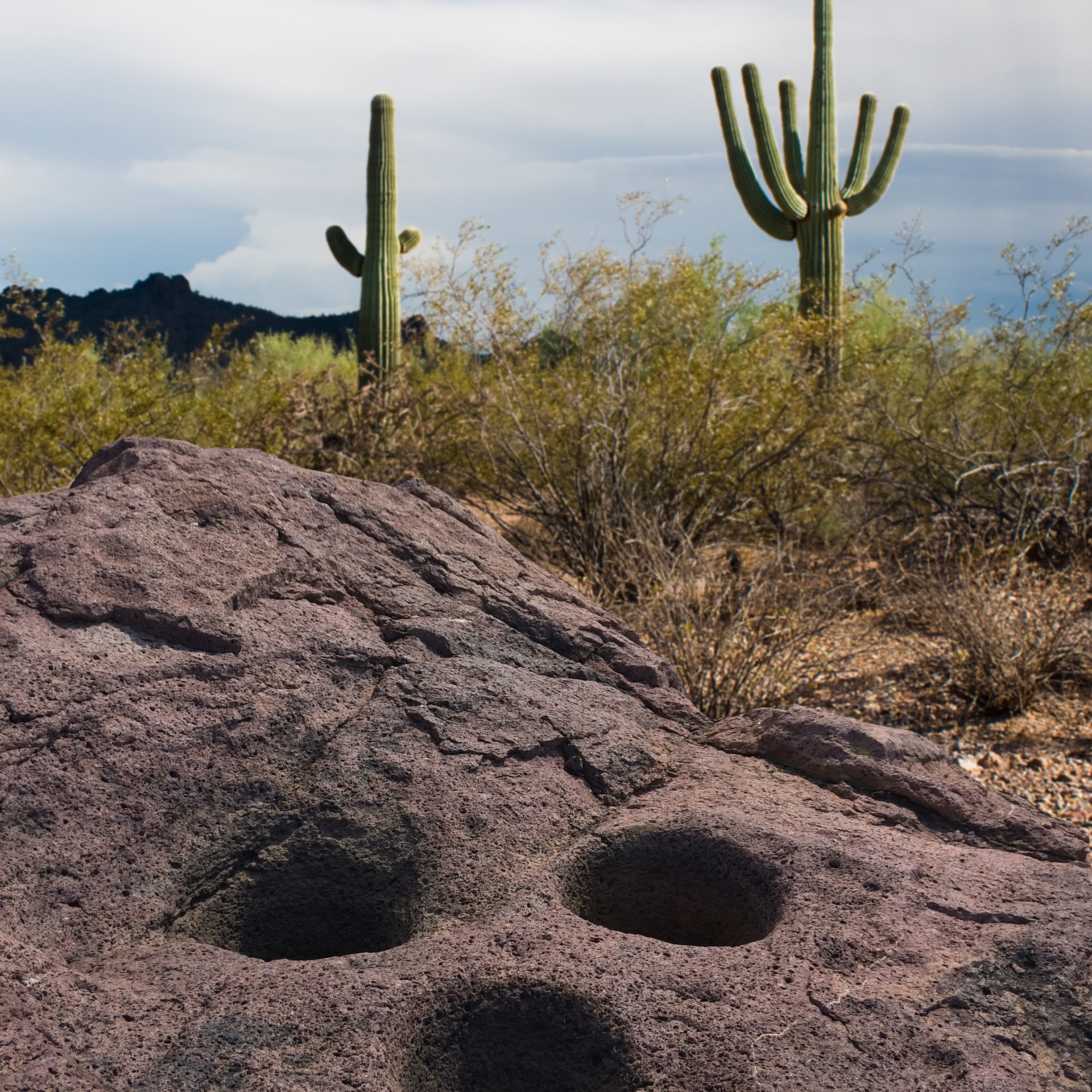
Ancient Hohokam mortar holes at Los Morteros Conservation Area in Marana. Courtesy Discover Marana.
Explore Marana
Use our Interactive Map to find heritage experiences in selected areas of the map.
Geography
A basin at an elevation of 1,991′ with a total area of 121.78 square miles of which only 0.56% is water, though the Santa Cruz River, which flows through Marana, and its watershed offered the ribbon of life that attracted human life for 12,000 years.
Two mountain ranges in the nearby vicinity offer a spectacular skyline and outdoor recreation:
• Tortolita Mountains to the east
• Tucson Mountains to the south
These Sky Islands offer fantastic hiking and mountain biking. Marana is also a Gateway Community to the 800-mile Arizona Trail.
Informative Links:
Resources:
Town of Marana
Juan Bautista de Anza National Historic Trail
Butterfield Overland National Historic Trail
Visitor Information:
Marana Visitor Information Center
Discover Marana
Visit Tucson
Visit Arizona
Helpful Maps:
Marana Maps
Santa Cruz Valley NHA Heritage Experiences Map
Place to Visit Map, Archaeology Southwest